From the moment I arrived at my mother-in-law's house this summer, I was confronted with Mexico in Spain. Mexico was everywhere. I realized that I inadvertently brought my little notebook from my 2021 first artist residency with Arquetopia in Oaxaca, Mexico. In it were extensive notes on Palestine, artists, thinkers, activists and conversations with the founder of the program. I read Edward Said, and Angela Davis Freedom is a Constant Struggle: Ferguson, Palestine, and the Foundations of a Movement. I joined Jewish Voice for Peace that summer joining meetings virtually from my solitude in the residency during COVID. I read the Oaxacan newspapers almost daily articles in Gaza. That was four years ago and now here I am in Madrid in Mexico. Exhibitions ranging from the Lady of Guadalupe in Spain at the Prado Museum, to Mexican photographer Graciela Iturbide’s body of work of ordinary extraordinary people at the Casa de Mexico en Madrid —There seems to be a Mexican Artistic Revolution in Madrid. Conducting research for two of my fall courses in the small villages of Galicia, Mexican history, art, music and artists are here beckoning invitations to trust my intuition to pay attention to our connections of humanity.
Throughout it all, Frida's ubiquitous brow - like the eyes of T.J. Eckleburg- adorns tourist merch: T-shirts, posters, coffee cups, and prints here in Spain- more than 5,000 miles from her home in Coyocan, Mexico.
She wasn't well known worldwide at the time of her death, having had only one solo show of her work in her home country. Yet, Frida's presence and vitality eclipses that of her husband, Diego Rivera the world-renowned Mexican muralist. I have always been inspired by Frida's vivacious and passionate default setting. Her art, intellectualism, relationships, social activism, curiosity, politics, successes, failures, and love affairs all intertwined. She hit bottom many times but remained true to her ideas about fellow human beings. I can't prove it, but I suspect that Frida would not have been silent about relentless murders and bombings of- civilian mothers, children and families anywhere. Frida always stood with the vulnerable.
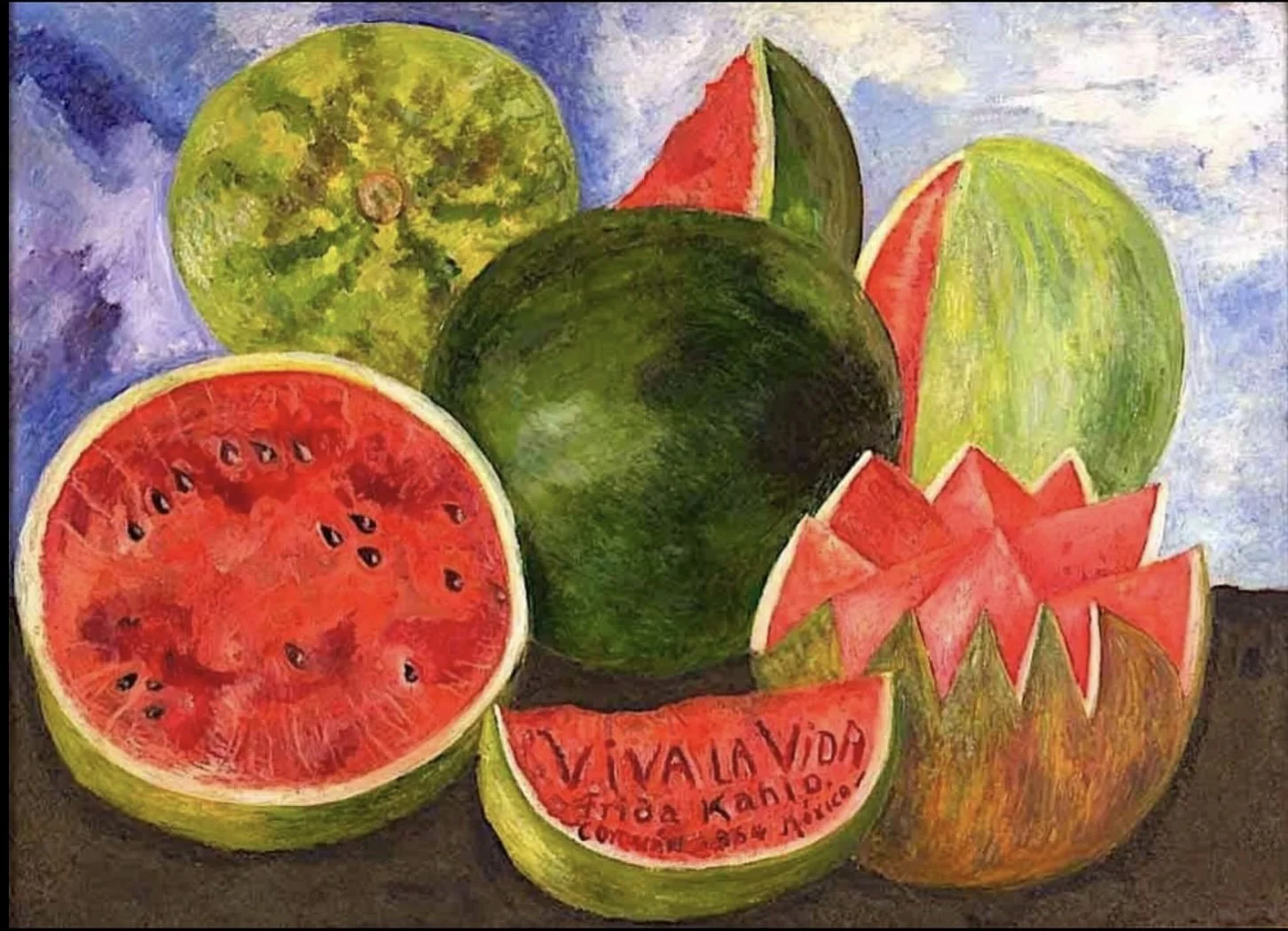
I'm a singer/songwriter and playwright. I wouldn't call myself a poet. I'm experimenting with lyrical writings intended for spoken performance. My new spoken work work in progress, “Viva la Vida” -a lesson from Frida was inspired by Frida Kahlo's last painting before her death called, "Viva la Vida." It's ironic and iconic Frida. Paradoxical as she celebrates life from her death bed, amidst suffering unbearable pain.
It's ironic that in the country of my birth, my home, one must revert to symbols and code words to avoid being censored for speaking truth about atrocities of war, about being against bombing civilians.
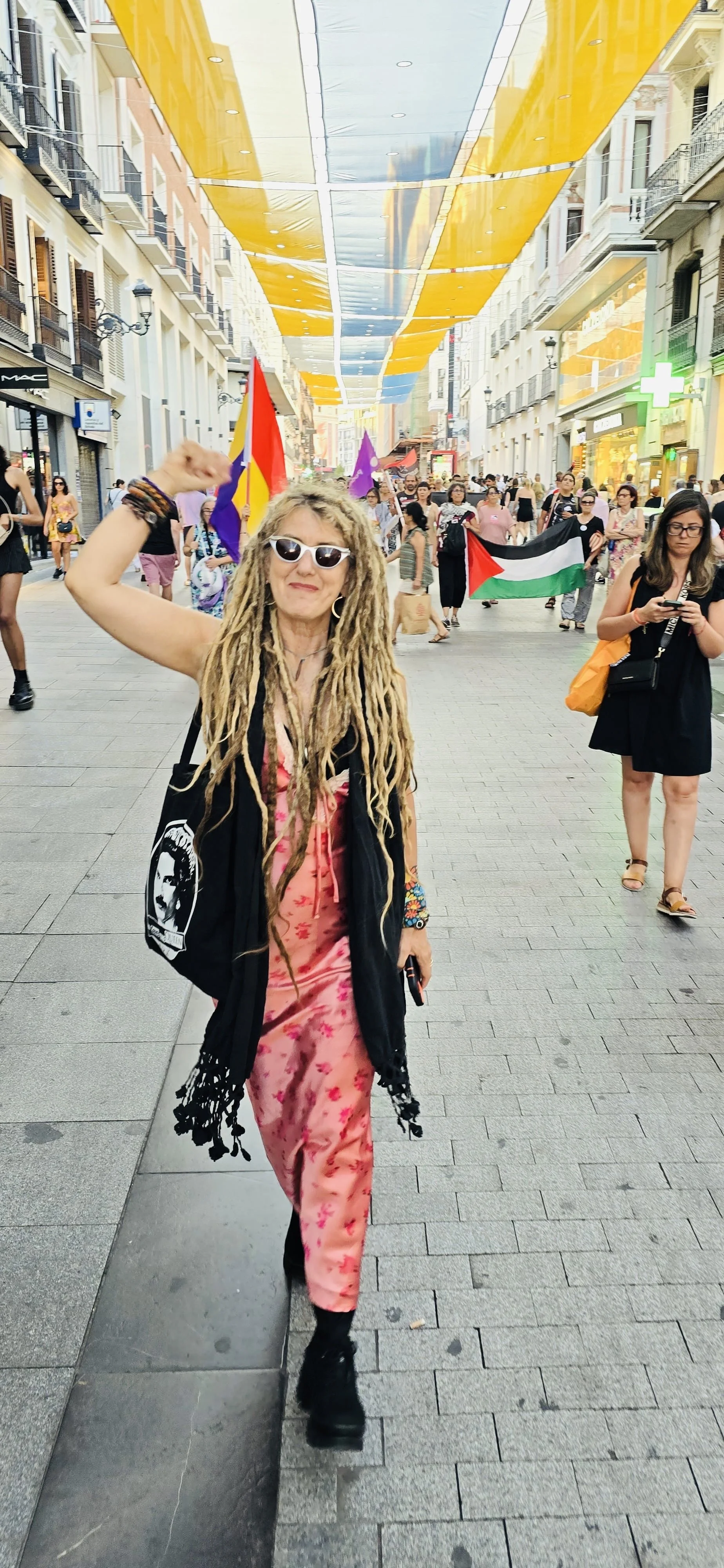
The watermelon, represents the Palestinian flag, solidarity with Palestinian people. It feels weird to use an almost "emoji-like" symbol for something so serious but, that is where we are. It is invigorating to find— again— the inexplicable magic of the language of art when I discovered that Frida's last painting, "Viva la Vida" is a painting of watermelons to celebrate life and resilience even amidst death and suffering. Here in Madrid- and all over Spain -- I've witnessed demonstrations of solidarity with Palestinian people with students, elderly, Jewish, African, immigrant, people standing together.
Even last summer I witnessed a crowd of supporters for Argentina’s far right president Javier Gerardo Milei-a very different ideaology — yet the protestors of Milei’s policies and mere presence in Spain were not grpeeted with violence. Protesters expressed themselves, waving their flags and chanting their mottos of opposition. Freedom of speech.
I often like to describe myself as having "No medium setting." It’s pretty accurate in general. There can’t be a medium setting regarding Gaza. Global media outlets have blocked truth about the constant killings of children and families of civilians seeking humanitarian aid in Gaza. The death toll has reached more that 50,000 with most of those being women and children. Artists, academics, bakers, writers, journalists, doctors, nurses, humanitarian aid volunteers, and their hospitals, bakeries, schools, universities and homes bombed to rubble. More than double the amount of the dead are the injured left starving, homeless, orphaned, lifeless, limbless. Humans are dehumanized.
We are muted from telling their individual stories I think in order to prevent empathy, care, support and dignity from empowering anyone. Don’t take my word for it. Dig on your own to find truth. It will jump off of the page, painting, poem, song, interview, and report when you see it. You won’t be able to turn away as easily. That is what those drunk on corruption and power don’t want. I read the stories of the few “allowed” to squeeze through the censorship. One of those is the poet, mosab_abutoha whose book Forest of Noise is honest, heartwrenching, painful and important.
Gazans aren’t the only people in the world suffering and experiencing blows of crimes against humanity, but if I can’t speak out against the atrocities for them, then my decades-long work on behalf of refugees and immigrants, non-traditional college students in my classrooms, women, people experiencing poverty, and other marginalized people experiencing discrimination is meaningless. It shouldn’t be controversial to speak out against bombing civilians. It shouldn’t have taken me this long. I don't think that what I say is that important. It is important though to speak my truth- clearly- and without the "medium setting.” It is way past time to speak up for Palestine.